Forty-Five Pizzas
The Tannery Marketplace in downtown Newburyport is an old mill building. Inside it there are shops and markets and small businesses stacked along brick hallways, and the whole place has the improvised feel of a building being used for something it wasn't built for. I like a lot of what's in there. But there's one place I keep thinking about after I leave, and it's a pizza shop.
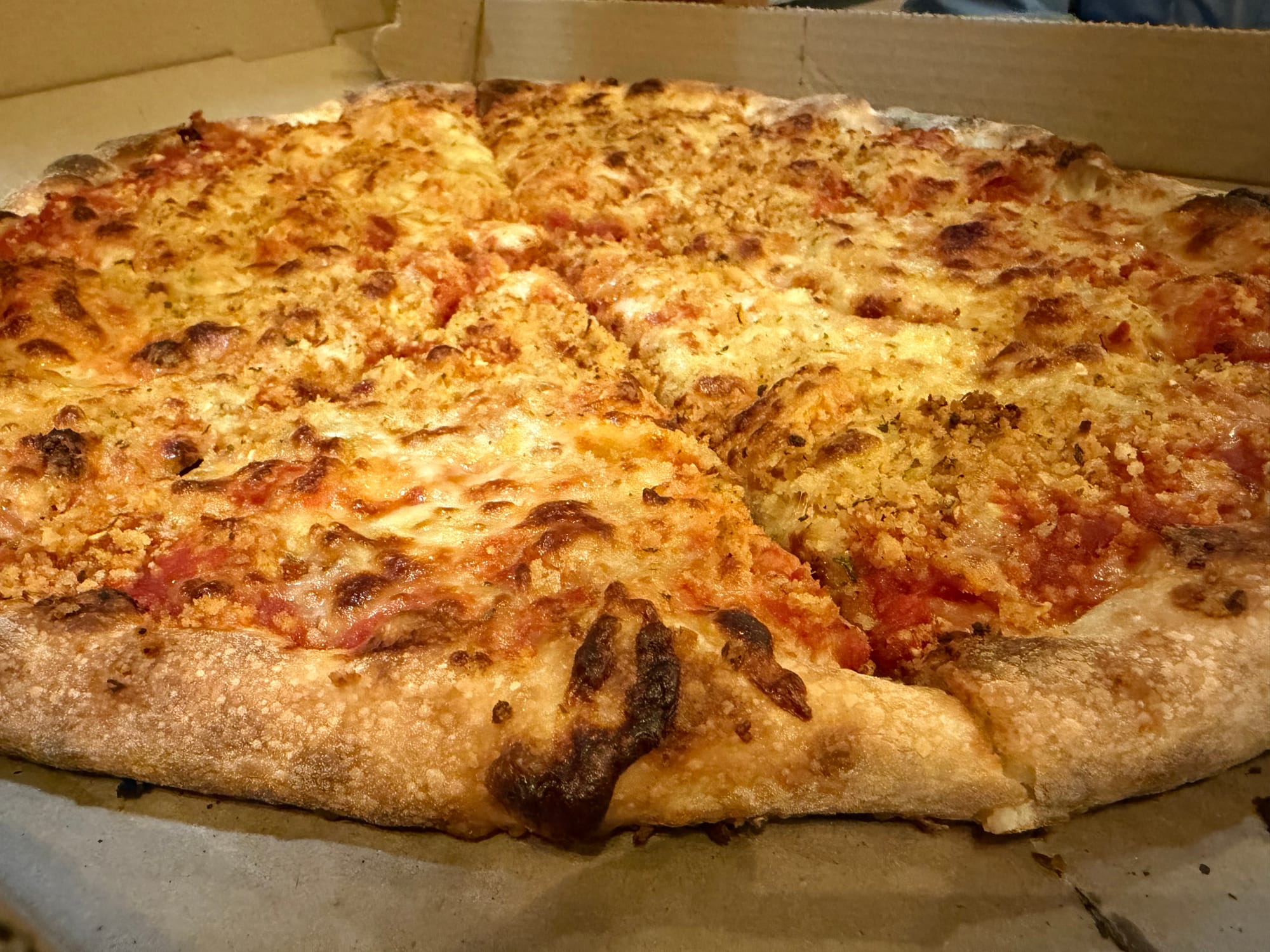
Epicureo is small. Not in the way a restaurant is small — small in the way a room is small. There's a counter, a register, a workspace, and an oven that takes up more of the footprint than anything else. That's it. There's no back. There's nowhere for anything to happen out of view. Tony Carbone is standing right there making your pizza, and you are standing right there watching him do it, because the geometry of the place doesn't offer either of you another option.
The pizza is worth the trip on it's own. None of the rest of this would be worth writing down if it weren't.
Most of what defines Epicureo is what it declines to do.
It's cash only. There's no online ordering. They don't sell slices, only whole sixteen-inch pies. They don't sell drinks. They don't sell sides. The dough is made daily in limited batches, which means they run out — usually somewhere between late afternoon and early evening — and when they do, the day is over. The website puts a number on it: about forty to forty-five pizzas a day.
Almost nothing else I buy is allowed to run out. The entire apparatus of modern commerce exists to make sure of it — more inventory, more locations, more hours, more throughput, an app so you can order before you arrive and a kiosk so you don't have to talk to anyone when you do. A hard daily ceiling is the exact problem that most of the last thirty years of retail engineering has been organized to eliminate. Epicureo has one anyway.
Forty-five pizzas is a quantity small enough that the dough can be judged rather than measured, that a pie can be watched rather than timed, and that the same pair of hands does every step. Every constraint on that list is doing similar work. No slices means no pie sitting under a lamp waiting to become somebody's disappointment. Cash only means no terminal, no fees, no interchange, no third party taking a cut of a business that runs on volume it has deliberately declined to have.
The last time I was in there, a couple of kids were at the counter talking to the staff about their games — what team, who they played against, how it went. It wasn't just polite chit chat. They were actually talking, the way you talk to someone who has asked you about this before and will ask you about it again. Nobody was waiting on them to finish so the transaction could proceed, because the transaction wasn't the point of the interaction, and there was no queue-management system signaling that it should have been.
When I ordered to eat there, they offered to set me up. Seating at Epicureo means the hallway of the Tannery, so they prepare a table by bringing out a pizza riser tray and a stack of plain paper plates. It is the least engineered hospitality I've experienced in years. Nobody is optimizing a table turn in a mill building corridor. They just wanted me to have somewhere to sit.
Epicureo doesn't sell drinks either. The Black Duck Market is next door, so you walk over and get what you want. The ATM is there, too.
In most modern accounting, that's revenue handed to a neighbor. Beverages are famously the high-margin item in food service; not selling them is the kind of decision a consultant would flag in the first hour. But it also means Epicureo isn't trying to be a complete experience. It's trying to be one good thing inside a building full of other things, which is a different posture entirely — less a business capturing a customer than a shop occupying a block. The value doesn't accumulate inside their four walls. It accumulates in the hallway.
The open kitchen matters for the same reason. You can watch the entire process. Not a curated glimpse through a pass-through window, not a "watch our chefs at work" feature bolted onto a dining room, but the actual unedited sequence of a person making the thing you're about to eat, because there's nowhere else for it to happen. Almost nothing else I buy works this way. I trust my other food, my software, my bank, and my groceries on the strength of a brand promise — a claim made by an entity I will never meet about a process I will never see.
I don't know their books. Running a shop like that is almost certainly harder and more precarious than a paragraph of admiration from a customer can convey, and I'm aware that "constraint produces quality" is a sentiment that goes down easy when you're the one eating the pizza rather than the one making the dough at six in the morning. This isn't a model anyone can adopt. It's a set of choices that work at this size, in this hallway, for these people, and would probably stop working at any other size.
What I can't stop thinking about is that every single one of those decisions — cash only, no drinks, no slices, no app, forty-five pies and then we're done — shows up as a loss in the only ledger most businesses are keeping. Lost sales, lost margin, lost throughput, lost convenience. The thing they're actually producing doesn't have a column. There's no field on the spreadsheet for a kid getting asked about his game, or for watching someone make your food with their hands, or for the fact that I've now spent several weeks thinking about a pizza shop.
So I've started asking a different question when I'm somewhere else. Not why can't more places be like this — that one's easy, and the answer is usually money. How many of the conveniences I've come to expect were actually removals? Every kiosk replaced someone I would have talked to. Every app replaced a moment of walking in and momentary adventure. I said yes to all of it, mostly without noticing, because each individual trade was small and each individual trade was framed as something I was getting.
Epicureo is a useful place to stand because it makes the trade visible in the other direction. It gives up the things that are easy to count and keeps the things that aren't, and the result is forty-five pizzas a day and a space where people talk to each other.
I know I keep going back.