The Button Nobody Answers
Danny Katch, We used to be able to buy things in this country ↗:
Self-checkout and locked up products may both be driven by management's desire to reduce staffing, as Mull notes, but in combination they create a nonsensical system: have your staff walk around unlocking cases and handing customers items they will then not pay for because your staff will not be working at the checkout machines. Great plan, boss!
He does the work: the NRF claiming organized retail crime was half of all shrink in 2021 and later retracting it, the estimate closer to five percent, Walgreens' CEO conceding in 2025 that "when you lock things up… you don't sell as many of them. We've kind of proven that pretty conclusively." A panic, not a response to evidence, and an expensive one.
I have one small piece of field evidence.
A few weeks ago I needed Prilosec. Doctor's orders, over-the-counter, it's not a dramatic errand. I went to my local CVS and stood in the aisle where it's supposed to be. I didn't check the locked case at first, because why would you lock up an OTC med? Eventually, having failed to find it on any shelf I could reach, I looked behind the locked glass. There it was.
Fine. Find an employee. I walked up to the front of the store, which is where employees used to be, and found only self-checkout machines. Nobody was stocking the aisles either. So I went back to the pharmacy and got in line, and worked out somewhere around the third minute that the line wasn't for talking to a person — it was for typing my name into a kiosk to pick up a prescription, which was not the thing I was there to do.
Eventually I flagged down an employee who was very clearly doing three people's jobs, and he asked if I'd pushed the button.
I did not know there was a button. He walked me back to the case and pointed it out.
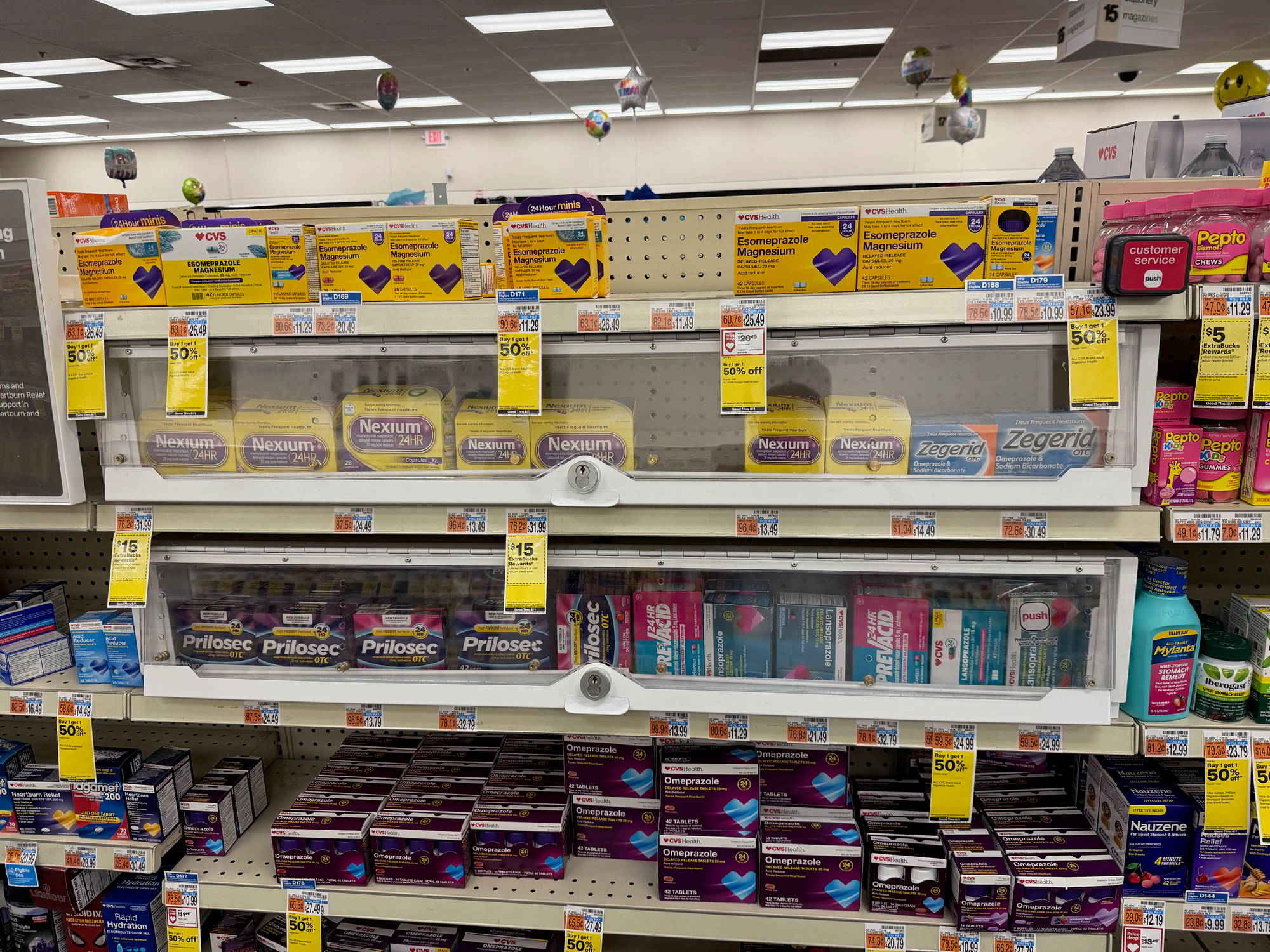
It's bright red, which suggests somebody meant for it to be found. It's also small, mounted at the far end of the run on a shelf of Pepto-Bismol, several feet from the lock it's supposed to open, which suggests otherwise. He pushed it, assured me someone would be with me shortly, and went back to the pharmacy.
Nobody came. And I had no way of knowing whether the button had done anything at all. No light, no chime, no request received. I don't know if it rang somewhere. I don't know if there was anyone on the other end of it to hear it ring. An interface with no feedback is indistinguishable from an interface that isn't wired to anything.
After five minutes of standing there in front of a locked glass box of fucking Prilosec, I left. I drove to my local Market Basket, which is staffed by humans, has no self-checkout, and keeps its heartburn medication out where we untrustworthy animals can reach it. I bought it in about ninety seconds.
The button is the artifact of the arrangement Katch describes. Locking the merchandise up invents a job — somebody now has to walk over and open the case — at the same moment the staffing model is built on not having anybody to send. The button is what you install in the gap. It takes the person who used to be standing in the aisle and converts them into a request submitted to an unspecified recipient, and it relocates the waiting onto me, where it's free.
And none of that shows up anywhere in the data. Consider what CVS recorded that afternoon: nothing. No transaction, no abandoned cart, no exit interview, no line item that reads customer stood in the aisle for five minutes and then bought it somewhere else. Maybe the button logged a press somewhere, but a press isn't a person, and a person isn't a sale that didn't happen. The 2024 survey Katch cites — the one where nearly half of customers say they'll just order from Amazon when they hit a locked case — is a survey. Somebody had to go out and ask people, because the stores can't see it from the inside.
My lost sale isn't data. It's evidence, which is what a person has; data is what a company acts on.
I'm patient about this stuff. I don't yell at retail employees, I don't think the kid covering three jobs owes me anything, and I have a high tolerance for working a badly designed system to get what I came for — read the sign, find the kiosk, push the button, wait. This was the one that finally exceeded it. If it lost me, it lost people with less time and less slack long before I walked in. Nobody counted them either.
Market Basket asks me to pick up the box and pay for it. CVS asks me to push a button and take it on faith that somebody heard. Both stores are the result of decisions made recently by people who could decide otherwise, and only one of them will ever find out what its decision cost.